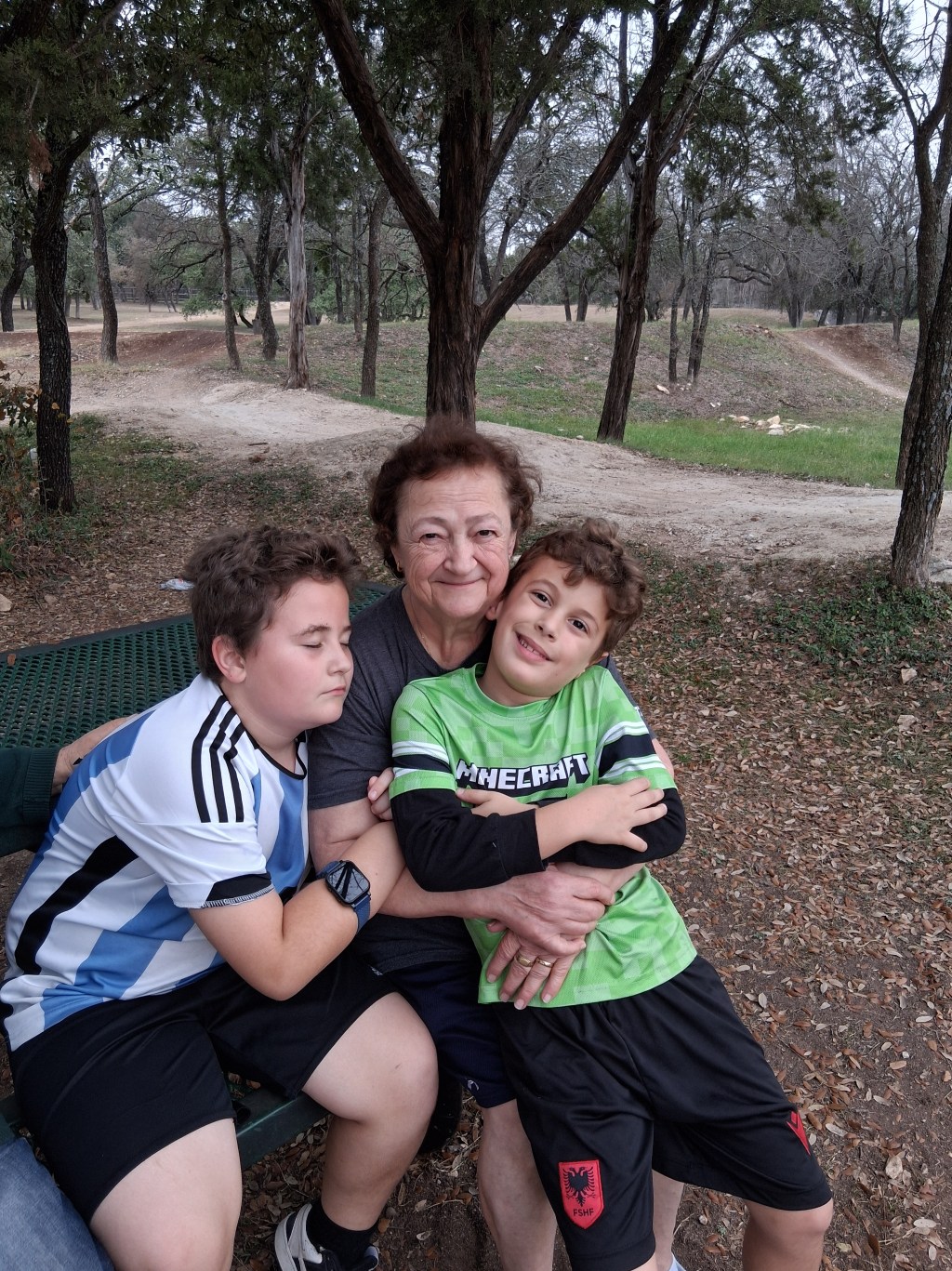
Some mornings I come down the hallway to find Nena already in the kitchen.
She doesn’t ask if I want help. She just starts. The coffee is on, something is simmering, and the counter has that particular kind of productive mess that means she’s been up for a while. I’ve had to make a quiet peace with this — the kitchen that used to be mine running perfectly well without me. It’s a small thing to give up. And I’ve come to see that it gives her purpose while our boys are at school and the house gets quiet.
This is our life right now: three generations under one roof. My Albanian in-laws — Nena and Gjyshi — arrived with a one-way ticket, and we’re figuring it out as we go.
They lived with us once before, when the twins were newborns. That season was harder — a small house, a language barrier, the particular overwhelm of four adults trying to care for three very small children with different ideas about how to do it. Everyone was acting from love, but love and exhaustion in a crowded house can still make for a tense afternoon.
This time is different. Our boys are older. They move through the day with more independence. And all of us, I think, have learned to let go of more.

Still, there are adjustments. We’ve had to teach our boys simple things — knock before entering Nena and Gjyshi’s room, no bouncing balls in the hallway. They love their grandparents so much that they will absolutely take a mile if given an inch. And because Nena and Gjyshi don’t speak English, there are moments when a discipline conversation happens right in front of them and they can only watch, reading our faces and our boys’ reactions and drawing their own conclusions. That adds a particular kind of weight to hard parenting moments.
I also have to watch myself. My instinct toward small frustrations, toward nitpicking — it doesn’t disappear just because we have company. It requires more intention.
But then there are the other moments.
On weekend mornings, Michael and Gjyshi take slow walks together around the neighborhood. Just the two of them. And somewhere along the way, one of them will pull out a phone and open Google Translate. They type and wait and listen, and sometimes it works beautifully — a real exchange, a laugh, a moment of genuine understanding. And sometimes the translation comes back so garbled that they end up more confused than before, which makes them laugh even harder. What strikes me about it is that they both keep trying. Michael and his grandfather are not similar in many obvious ways, but they share this: a deep need to connect, to be understood, to feel close to the person right in front of them. The app is just the bridge they’ve built with what they have.

And Jamie, who can struggle to sit still for homework, will sit beside Nena for as long as it takes. She was a math teacher in Albania, and something in the way she explains things reaches him. Our boys have picked up basic numbers in Albanian along the way — enough to follow her when she counts through a problem or points to an answer — and watching them respond to her in her own language, even just a little, is one of those small things that fills me up. I watch Jamie and William bent over the same page together with her — her pointing, them nodding — and I think: this would not exist if we hadn’t made room for it.
That’s what I keep coming back to. Living together isn’t only about practicing patience, though there’s plenty of that. It’s about making space for relationships that wouldn’t have had the chance to grow otherwise. My boys are growing up knowing their grandparents — not as people they visit, but as people they live alongside. People who know their rhythms, their moods, which one needs quiet and which one needs to be heard.
It’s not perfect. Some days the kitchen feels small and the language barrier feels large and I catch myself longing for a version of this that is easier.
But then Gjyshi comes back through the front door from his walk with Michael, and they’re both a little windswept, and Michael is talking more than he has all day.
And I think: this is what rooted looks like.
 Rooted at Home
Leave a comment