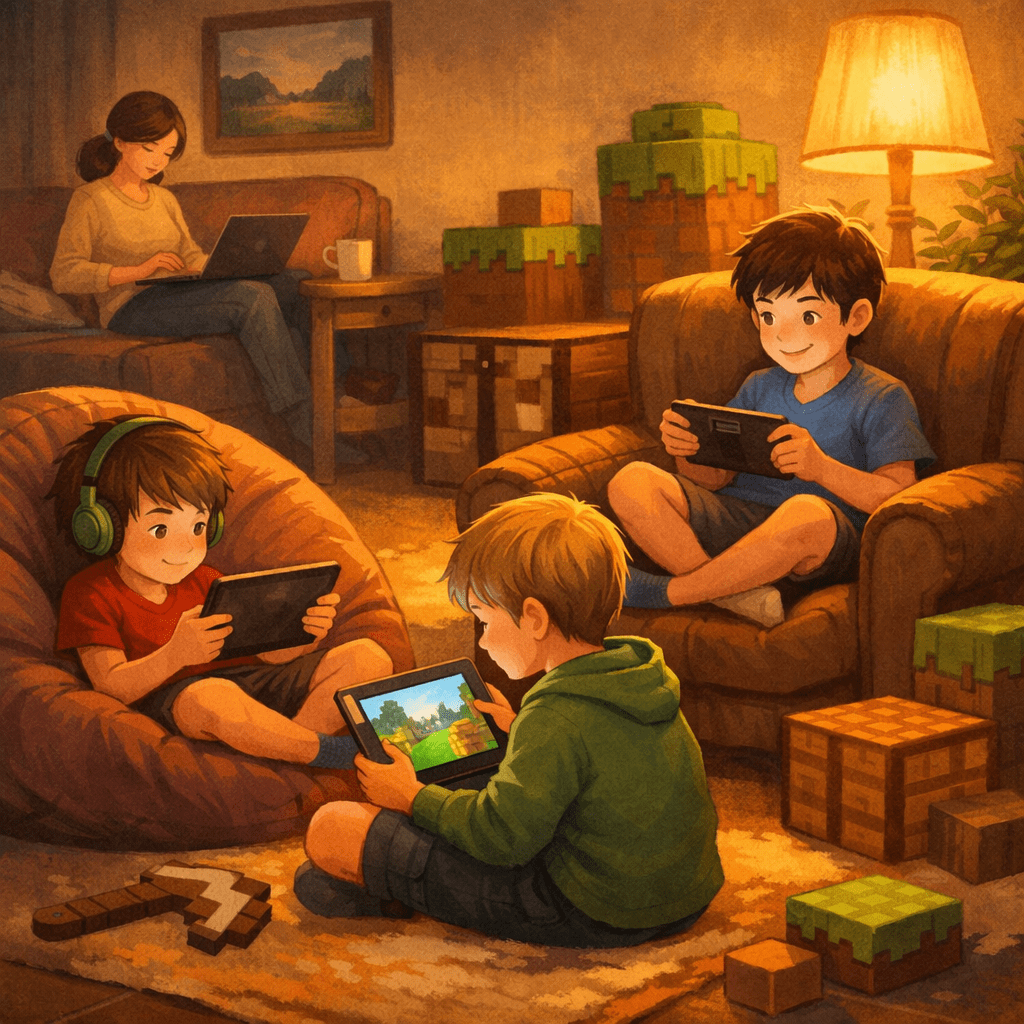
Tonight I moved into the living room to listen to the world my children were building — a world that, as it turns out, runs almost entirely on Minecraft negotiations.
Screens glow in three corners of the room, and the air fills quickly with the running commentary of strategy, discovery, and the occasional urgent warning about monsters appearing after dark.
Jamie has claimed the lazy-boy chair — his iPad charging, as usual, from the outlet nearby. William, as always, has folded himself into that round, soft chair in the corner — his unofficial spot, every single time. Michael has stationed himself at the kitchen table, just within shouting distance of the others.
Michael created the survival world. This, I quickly learn, immediately establishes a hierarchy. The one who created the world has a certain authority over the laws of the land.
“Okay, everyone spawn near me,” he announces.
Within seconds, the others are negotiating.
“Wait — where are you?”
“I’m by the trees.”
“That doesn’t help. Everything is trees.”
Soon the planning begins. Resources must be gathered. Shelter must be built. Someone has already wandered farther away than intended.
“Don’t go that way!” Michael shouts. “That’s where the mobs spawn at night.”
William replies with complete confidence.
“It’s fine. I have a wooden sword.”
From my position on the couch, I’m simply listening. Their conversation rises and falls like the background noise of a small civilization forming in real time.
Michael has already built Jamie a house — payment, apparently, for important storage and supplies. In the economy of their Minecraft world, this justifies home construction. Michael is like that in real life too. When one of his brothers gets frustrated, he’ll quietly walk over, crouch down to their iPad, and just… fix it. No big deal. Just older brother doing older brother things.
I should note that Michael, for the record, does not play Minecraft anymore. He will tell you this himself, very clearly, especially if his friends are around. And yet here he is, three hours into a Sunday afternoon, running a survival world with his brothers and completely absorbed in it. I’m not going to say anything. Some things are better left unmentioned.
“Just survive the night,” someone declares.
That seems to be the immediate goal. The overarching mission is eventually to defeat the Ender Dragon, but for now the priorities are simpler: collect items, build shelter, fill storage chests.
“I’m getting so much wood!” William announces proudly.
From across the room, Jamie calls out, “Who wants to do cannonballs into my lake?”
“No, I’m busy getting carrots,” Michael answers without looking up.
A moment later William pipes up, “Guys, who wants some iron? I need some wood.”
Jamie responds with the authority of someone who has been keeping close track: “I think we’re doing okay on wood. My storage is already full.”
From the couch it sounds like the running commentary of a tiny frontier town — resources being gathered, houses being built, very serious negotiations happening over carrots, iron, and cannonballs into lakes.
They narrate everything.
“I found coal.”
“We need food.”
“Who took the crafting table?”
Then, inevitably, the accusations.
“You broke the door!”
“I didn’t break the door. The zombie broke the door.”
“Well why did you let the zombie in?”
I don’t mention that I’m fairly certain William has been quietly raiding Jamie’s supply chest for the past ten minutes. He has a talent for this — a very calm, strategic kind of mischief that goes undetected until suddenly it doesn’t.
Sure enough, a minute later: “WillIAMMMMM!”
Jamie. Absolutely beside himself.
William looks up from his screen with an expression of complete innocence.
Michael, without a word, gets up, walks over, and starts sorting it out.
And just like that, they’re back to work — rebuilding, gathering, heading back out to mine.
Every now and then one of them looks up from his screen and explains the latest development to me as if I’m a quiet partner in the whole operation.
“Mom, we built a farm.”
A few minutes later:
“Mom, we found diamonds.”
I nod with what I hope is the appropriate level of enthusiasm.
From the outside it sounds chaotic, but underneath it all there is a rhythm. They are building something together — negotiating, planning, failing, starting again. A tiny digital world, yes, but one that requires cooperation, imagination, and a surprising amount of patience with one another.
From the couch, it sounds like childhood unfolding in real time. I know these sounds won’t last forever — the dramatic announcements, the urgent warnings, the running commentary about wood supplies and Jamie’s very full storage chest.
So tonight I’m just sitting here, listening to the world they’re building together. And quietly grateful for this one too.
 Rooted at Home
Leave a comment