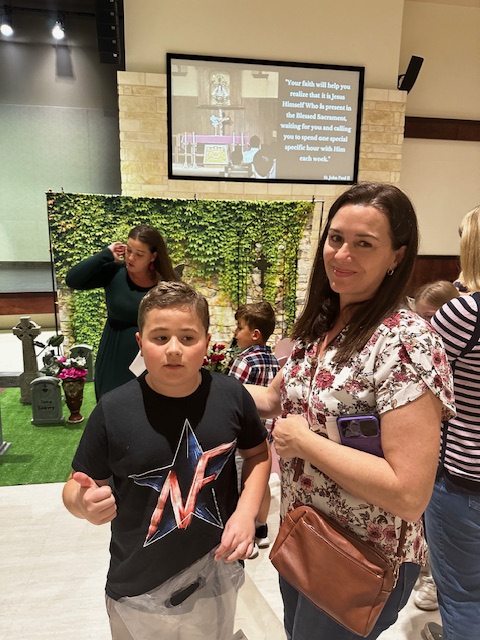
One small request had been made of each family attending the retreat: bring macaroni cups and applesauce pouches for the parish food pantry.
Simple enough. And yet somehow, between the week’s errands and school pickups and the general noise of a full house, I arrived at Saturday morning empty-handed. I hadn’t decided not to bring it. I had just never quite decided to.
On the way to church Saturday morning my ten-year-old asked about it from the back seat. I told him I had forgotten but would bring it the next day. He nodded. But later that afternoon he brought it up again.
“But why? We were supposed to.”
There was no accusation in his voice. Just confusion — and something underneath the confusion that was harder to name. By the end of the day he told me he felt ashamed that we had shown up empty-handed.
That was exactly how I felt.
I apologized to him. And I sat with the quiet embarrassment of having my son witness this part of me — the part that grows weary, that lets small responsibilities slip, that does not always rise to the moment. I told him he was right to care. I promised I would bring the food on Monday.
This retreat was for our whole family — all three boys will receive their First Communion this May, and the day was meant to prepare both children and parents for what the Eucharist actually means. During the parents’ session we talked about Christ’s sacrifice and the mystery of receiving His Body and Blood. One line stayed with me: when we come forward to receive the Eucharist, we are not only receiving. We are also bringing ourselves as an offering.
That thought unsettled me.
Because lately I have been holding back in small but concrete ways. Participation in parish life has felt more like obligation than invitation. Service has felt like one more demand rather than a privilege. I have quietly filed these requests under burdens instead of gifts.
But the Eucharist is not minimal compliance. It is total self-gift.
My son understood that before I did. While I saw inconvenience he saw responsibility. While I saw one more errand he saw an opportunity to contribute. He is ten years old and he felt ashamed to arrive empty-handed at a place that had asked something of us. I am his mother and I had talked myself out of it somewhere between Tuesday and Saturday.
Love does not wait for leftovers.
It is Monday morning now. I fully intend to follow through today. But what has stayed with me is less about the macaroni and more about what his persistence stirred in me — the recognition that my children are not just watching what I teach them. They are watching how I respond when something small is asked of me and it isn’t convenient. They are noticing whether I treat community needs as interruptions or as part of our offering.
This May, when my boys walk forward for their First Communion, I don’t want us to come empty-handed — spiritually or practically. I want to come willing to give, not just ready to receive.
My son is forming me as much as I am forming him. I didn’t expect that. But I am grateful for it.
 Rooted at Home
Leave a comment