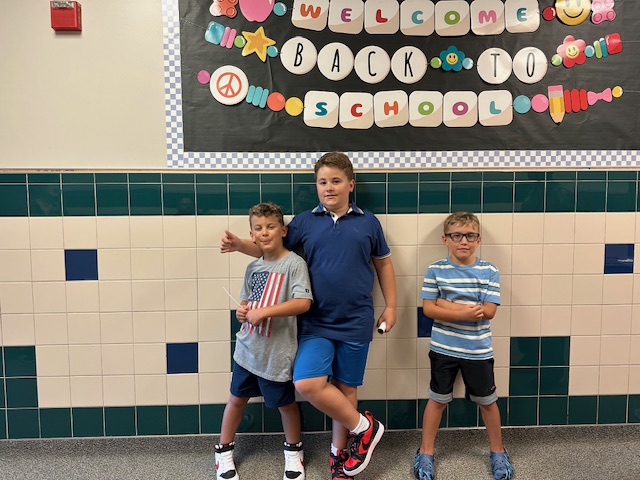
The kids felt normal.
That was my first thought walking into the Catholic school back in October — and I mean that literally. I hadn’t even made it past the front office yet. Students coming in and out with jobs to do. Office staff talking with them like people. A handful of parents gathered for the tour, administration moving through the room with easy familiarity. Before I saw a single classroom, before the tour had even started — just standing there in that front office — I could already feel something different about this place. I recognized the assistant principal for the younger grades — she was a sponsor coordinator from our own parish. My oldest son’s faith formation teacher was there substituting. It felt like walking into a place that already knew us a little.
I could breathe.
I want to be honest about what I came in with that morning. We were still learning the Catholic faith. I had no blueprint for any of this — not for Catholic school, not for private school in general. All I had was word of mouth: that this school was authentically and faithfully Catholic, that the reviews were good, that people who knew it spoke well of it. I walked in on nothing but that and a little hope.
As the tour moved through the buildings I kept noticing things that felt alive. In one building I heard it before I saw it — band, choir, a general music class with Orff instruments and children actually moving and dancing. Spanish and Latin both offered. In the science lab a nun was guiding seventh graders through a demonstration, unhurried and engaged, while the yearbook club moved quietly around the edges documenting everything. Teachers teaching. Students discussing. Things being built and figured out together.
The fifth and sixth grade building was older, and the boys in the hallway were — well, they were fifth and sixth grade boys. Lockers slamming, a little loud, that particular brand of awkward that belongs entirely to that age. I caught myself smiling. I could picture my oldest in that hallway in a year or two, finding his people, figuring out who he was becoming. These were not polished students. They were just boys — regular, silly, still learning how to be in the world.
That felt exactly right.
I drove home from that October tour knowing exactly what I wanted for my boys.
And then I spent the next two months looking for a cheaper version of it.
The idea of a classical charter school had been pulling at me for a while — structure, high expectations, no technology, handwritten notes, Latin, primary sources, Christianity woven in openly. Since Catholic school tuition still felt out of reach, a classical charter seemed like it might be close enough. I had all three boys on the waitlist.
The younger campus — where my twins would attend — was the one I had toured earlier in the year, and the distance felt manageable. That part felt workable. What I hadn’t yet seen was the upper campus, still under construction, set further away — the one my boys would eventually move into as they got older. A half-hour drive each way, more in traffic. I knew that going in. I told myself it would be worth it if the school was everything it promised to be.
Then, one week before Christmas break, the registrar called. Two second-grade spots had opened — one for each of my twins, in separate classes, starting second semester. The hope was that enrolling them would bump my oldest up on the fourth-grade waitlist too. I said yes without hesitating.
Christmas break became a scramble. Uniforms, belts, new teachers, new expectations. I was proud of how my boys handled it. They hadn’t expected the change but they walked into that lobby on the first day with quiet obedience, ready to follow wherever they were led. First week: homework done, uniforms on, positive behavior notes coming home. I signed up to substitute teach. I felt like we were building something.
The second week I was invited to spend a full day observing the upper campus — third grade through high school. I drove the extra distance with genuine anticipation. I expected to feel reassured. I expected to come home certain.
Instead I came home and called our neighborhood school to ask if my twins could return.
Here is what I saw.
The walls were bare. Not the intentional minimalism of a focused learning environment — just bare. No student work, no anchor charts, no evidence that children had been thinking hard about things and putting those thoughts somewhere visible. Room after room, the same blankness.
In a fourth-grade math class, a student raised his hand with a question. The teacher tried to answer it. He was still confused — you could see it on his face — and she moved on. I stood there thinking of the three or four ways I might have broken that concept down differently. She did none of them. She moved on. That moment stayed with me longer than anything else that day.
Then I found the music room.
One class. The only music class in the school. Sixth graders working through music theory — reading notation, identifying intervals — with no instruments in the room and no singing happening. I am a musician and a music teacher. I stood in that doorway and felt something close to grief. Music theory without music is like teaching someone to read without ever letting them open a book.
Outside, fourth graders were being handed laptops for the first time — given a single day to get familiar with the keyboard before taking a state test the next morning. A whole day. To learn to type. These were children who had been in a technology-free environment, now handed a tool they didn’t know how to use, twenty-four hours before being tested on it.
And then there was the playground. Footballs coming at full speed across the same small patch of asphalt where girls were trying to climb the playscape. Thirty-five children in a space that couldn’t safely hold half that number. Jamie had already broken a finger on the younger campus. Standing there watching the older one, I understood completely how that had happened.
I saved the hardest room for last. A tenth-grade class working through Greek philosophy and its connections to modern government. The content was serious. The teaching was careful. But the students — fifteen and sixteen years old — sat quietly, taking notes, offering little. When questions were asked, the answers came slowly and cautiously, as if the wrong answer carried a cost. By tenth grade I want to see students who have started to become something — independent thinkers, people with emerging convictions, young adults who have learned not just to receive knowledge but to do something with it. These students were diligent. They were obedient. But they were not yet on fire.
I drove home quiet.
Somewhere on that long drive back — the one I had been willing to make every single day — I stopped thinking like a teacher and started thinking like a mother.
I thought about my twins — Jamie and William. Jamie has these big brown eyes that search a teacher’s face looking for connection, waiting to be seen. William — my quiet observer, the one with glasses who reads everything he can get his hands on — cannot help himself. He will notice something the rest of the room missed, make an observation out loud, ask the question nobody else thought to ask, and follow a thread until it takes him somewhere interesting. I thought about my oldest, Michael, my ten-year-old optimist, the one who walks into every room looking for his people, ready to make someone laugh. I tried to imagine all three of them in those quiet, bare-walled rooms for the next twelve years.
I couldn’t do it.
What I could picture was the burnout. The slow dimming of something bright. A kind of cynicism that sets in when curious children spend too many years being asked only to receive and never to become.
That was the moment I knew. Not a new knowing — just the one from October, finally admitted out loud.
By the end of that week I had called our neighborhood school. The answer was immediate and warm: of course, come back.
The following Monday all three boys walked the three blocks to their school together — Michael, Jamie, and William, with Jamie especially eager to show his classmates the evidence of his broken-finger adventure. Watching the three of them walk side by side down that familiar street, I felt something loosen in my chest. They were still in the season of life where they got to do this together. I didn’t need to rush that.
For now they are back where they belong. And I am still working on what comes next — the applications, the voucher program, the timeline. Nothing is settled yet. But I know what I am working toward.
A school where the kids feel normal. Where you can breathe when you walk in. Where a nun helps seventh graders set up an experiment in the science lab and the yearbook club is there to catch it.
That’s what I’m looking for. I already found it once. I just have to find my way back.
If you’re navigating school decisions, faith, and what it means to raise children with intention — Rooted at Home is where I think through all of it. Subscribe at rootedathome.substack.com and come along.
 Rooted at Home
Leave a comment