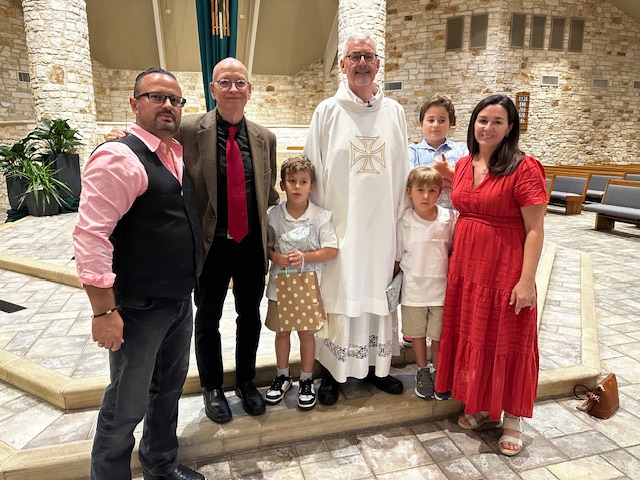
Soon after Erjon’s baptism, Michael — eight years old — decided he wanted to be baptized too.
I wasn’t surprised. He had watched his dad from the back of that rainy outdoor service, and something had settled into him quietly. The church offered a full Saturday class — about fifty children and their parents gathered to learn what baptism meant, why Jesus asked us to do it, what they were declaring. I sat there moved and proud. Michael talked the whole way there about watching his dad, how much it had meant to him, how much he wanted to follow his father’s lead.
It was one of my favorite moments I’ve ever witnessed.
But the contrast wouldn’t leave me.
Here was my eight year old — prepared, taught, walked through every step. And here was his father — the man Michael was already watching every day, already modeling his faith after — who had stepped into baptism with a warm heart, a warm tank of water, and a phone call the day before.
Erjon didn’t have much to go on. And Michael was watching.
I wanted more for him. For both of them — for all of my boys.
I wanted something rooted. Something that acknowledged the growth and connection to the Church of the ages. Because God is big. And I wanted to SEE big.
God gave us signs. He gave us senses. And I wanted to use them. I wanted to see what my little human eyes could appreciate — symbols and images and beauty that pointed upward, that said this is sacred, this matters, this is real. My every day life was hard and dry and relentless. And I came on Sunday desperate to be filled — not just by a message, but by space and time to pray and see and hear. To encounter something larger than the week I had just survived.
I needed all the help I could get.
I saw the gap most clearly through Erjon’s parents.
They had grown up in Albania, surrounded by the old world — Orthodox Christianity, Catholicism, ancient faith embedded in stone and symbol and centuries of history. They respected it because it had always been there. And then they sat in our church — the praise band, the blank walls, the bright auditorium — and they liked the people. They genuinely liked the people. But they didn’t understand that this was Christianity. They thought it was a nice group of people gathering together. Where was the sign of the cross? Where were the symbols of prayer? Where was anything that said — this is sacred, this is ancient, this is the faith that has endured?
I had learned to live with the absence of those things. They were easy enough to set aside when the community was warm and the faith was sincere. I missed them — quietly, without quite knowing what I was missing — but I was managing.
And as I searched for faith formation resources — anything that could help me prepare Erjon, help me teach my boys — I kept noticing something.
Catholic resources kept showing up.
I wasn’t looking for them. But there they were — every time I searched for something substantive about baptism, about formation, about the roots of the faith. I noted it. Set it aside. Kept looking.
Surely there were Protestant churches with this kind of depth. And there were a few. But here was my dilemma — a semblance of tradition was there, but the moral framework I was looking for had quietly shifted. The groundedness in Scripture. The clarity on how to raise a family. The willingness to say — this is true, and this is not.
I wasn’t willing to make that trade.
And the Catholic Church kept showing up in my searches.
One afternoon, scrolling through a Facebook group for Christian moms, another mother shared a link. Just one link. I clicked.
I started reading. And then kept reading. I scrolled down and back up, grabbed my Bible to check a reference — well, what do you know, it does say that — and scrolled back down again. The document went on and on, dense with numbered footnotes, names I didn’t recognize. “Father” this, “Bishop” that. Abbreviations I couldn’t place. And woven through all of it: scripture. Page after page of scripture.
I scrolled to the very top.
It was the prologue of the Catechism of the Catholic Church.
I had no background in Catholicism — if anything, I’d only ever heard small things about it, and not usually in a positive light. So this felt genuinely unexpected. I spent that whole weekend reading.
And I stopped trying to find words at all.
I grabbed my Bible.
I started looking up every Scripture reference footnoted in the prologue. One after another. And they were there — all of them — exactly where the Catechism said they would be. Not twisted. Not taken out of context. Just there, plain and clear, saying exactly what they had always said.
And something unsettling settled in.
Because I began to realize that the faith I had been handed — sincere as it was — had been curated. Certain concepts emphasized. Certain elements quietly set aside. Not out of malice. Not out of deception. Just — incomplete. Like a map that shows you some of the roads but not all of them. You can still get where you’re going. But you don’t know what you’re missing until someone hands you the full map.
I had been reading the same Bible my whole life. And somehow this entire world of thought had been sitting right there in its pages — and nobody had shown me how to see it.
And then a terrible, clarifying dread settled in.
Because now I knew too much. I couldn’t turn back. I couldn’t ignore this. Part of me still wanted to — back to the warm coffee stations in the church lobby, the inspiring Sunday messages, the praise songs. That life had been sweet and real and full of people I loved.
But everything was turned upside down now.
I went to Amazon. And for the first time in my life I typed words into a search bar that I had never dared to type before.
It sounds like a small thing. It wasn’t.
Because typing those words was an admission — to myself, quietly, with nobody watching — that I was actually considering this. That the curiosity was real. That the possibility was real. That I wasn’t just stumbling across Catholic resources anymore. I was looking for them.
I was looking for a book about a Protestant becoming Catholic. A pastor, to be exact. Someone who had come from where I came from and ended up somewhere I was only beginning to let myself imagine.
And then there it was. Born Fundamentalist, Born Again Catholic by David B. Currie.
I ordered it.
And then I waited. The way you wait for something you’re not sure you should have ordered. Half hoping it would arrive quickly. Half hoping it wouldn’t arrive at all.
It arrived.
I remember sitting down with it for the first time — this book written by a man who had grown up exactly where I had grown up, theologically speaking. Who had asked exactly the questions I was asking. Who had followed them exactly where I was afraid to follow mine.
It gave language to questions I hadn’t been able to name. It met me exactly where I was — as a Protestant, with a Protestant’s fears and a Protestant’s instincts — and walked me through them one by one.
By the time I finished it I hadn’t said anything to myself about a decision. I hadn’t declared anything. I hadn’t crossed any line I could point to.
But my very next thought was: what about my children? What about Erjon?
And that’s when I realized I had already moved ahead. Somewhere in the pages of that book, without noticing, I had crossed the line. The only question left wasn’t whether. It was how.
Because this was going to be all or nothing.
I brought it all to Erjon. Not as a conclusion, not as a demand — just stuck with all this knowledge and needing to do something with it. And thank God, he was open. Open enough to say: maybe we should talk to someone.
He knew a priest through work. Before I had time to overthink it, we had an appointment.
I went in thinking I would explain everything. But the conversation didn’t go the way I expected.
The priest was warm and easy to talk with. He spoke kindly about Southern Baptists, which I appreciated more than he probably knew. And somewhere in the conversation I tried to describe where we were — what we’d experienced, what we’d read, what still felt incomplete.
I told him that what we had felt like a piece of a prism. Shiny and beautiful, and real. But that after reading the Catechism, I had the sense there was an entire chandelier still to discover.
He smiled at that. And then moved on — because he had something more to give me. He spoke of a thin veil between heaven and earth, of our prayers here being connected to something much larger. He spoke about the home. The family. What he called the domestic church. That the life of faith begins there. That parents are the first teachers.
That part stayed with me longer than anything else.
That September, Erjon and I began OCIA — the formal process of entering the Church. Every Thursday evening we arranged a babysitter and drove to a parish across town, meeting others who were asking their own questions, searching in their own ways. It didn’t overwhelm us. It just helped us begin.
After a few months we transferred to a parish closer to home. Our boys began their own formation classes. That felt natural — all of us learning together, just at different levels.
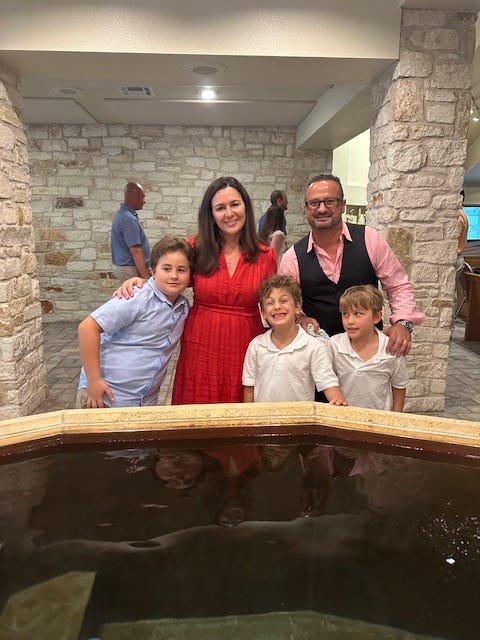
Jamie and William at the baptismal font with Deacon Dan — the moment just before.
Jamie and William were baptized the following summer, just before their seventh birthday. We asked Blane to be their godfather. He had worked alongside Erjon for years at the electrical company and had become the kind of friend who showed up for holidays, who always arrived with a little box of cake balls for the boys. That summer, as I was sharing what we were discovering, he listened quietly over dinner and then said that if we ever decided to join, he would love to be a godfather to our children.
That offer meant more than I can easily say. He was recently retired, with a full life of his own — and he was offering to walk alongside ours.
This spring, all three of our boys will receive the Eucharist for the first time.
Erjon and I are still on our own path. We won’t be fully received into the Church this Easter. That will come later.
But we’re here. Still learning. Still showing up.
And honestly — I think the chandelier is even more beautiful than I imagined.
— Sharon
If you’re following along with our family’s faith journey — or if your own life is full of questions that won’t stop growing — I’d love for you to subscribe.
 Rooted at Home
Leave a comment