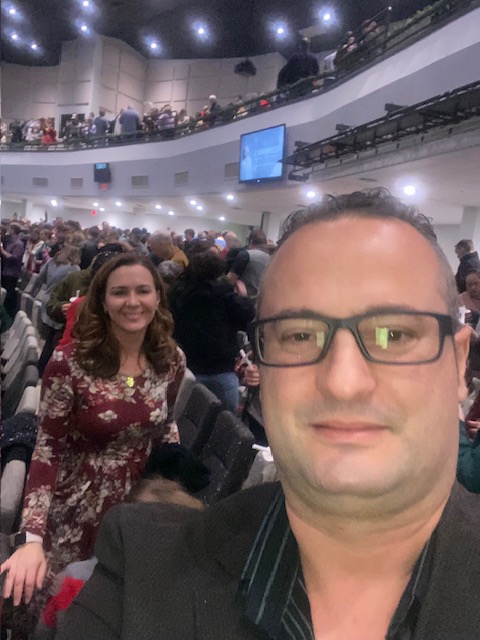
We did not set out to become a religious family.
For a long time, we weren’t one at all.
I grew up Southern Baptist, but somewhere along the way that part of my life quietly faded. In college I found my way into InterVarsity Christian Fellowship. Then I moved to New York City to sing and teach music, and my Sundays took on a different shape — I became a paid sacred soloist, moving from church to church not as a participant but as a guest artist. For a long time, that felt like enough.
Erjon came from something entirely different. He grew up in Albania during a period when religion had been removed from public life — no framework, no spoken community of belief, no real sense of what faith looked like lived out day to day. And when we met in New York, neither of us was really looking for church.
And for a while, that worked. Erjon was happy to come along with me to my concerts and watch me sing in the sacred spaces. The environment was artistic and beautiful, but nothing more.
It wasn’t until we had children that something began to shift. We had married, moved closer to my family, and had our first son, Michael. When he was two, maybe three, I found myself visiting churches again — not with urgency, and usually by myself — just searching. I wanted our family to have a place of worship — somewhere Erjon could enter comfortably, where my boys would grow up knowing their faith. And I wanted it settled before they were old enough to notice it had ever been absent.
Eventually we found our way into a non-denominational church. It was easy to enter — welcoming and simple — and that mattered for a family that didn’t have a background in church. My children loved the kids’ activities during the service, and we slowly found our footing.
Soon we integrated more into the church community and joined a local small group. We met regularly in each other’s homes, prayed together, and studied scripture. These were genuinely good, scripture-rooted people — serious about their faith, devoted to one another. Erjon had no blueprint for faith, but he could recognize sincerity when he saw it. And what he saw in these people was real.
Then one Halloween, Erjon came down with a very high fever. The emergency room, some tests, and a diagnosis: appendicitis. That same evening he was in surgery — his appendix removed, part of his colon infected. What followed was a week-long hospital stay, scrambled schedules, family and neighbors stepping in to hold things together.
And those same people from our small group showed up.
Meals. Help. Presence — day after day. The kind of help that stays with you long after the crisis has passed.
A few months later, Erjon decided he wanted to be baptized. I understood why. These sweet friends had shown him something he hadn’t seen before — love that showed up, faith that had legs. When it mattered most, they were there. This small group — serious, scripture-rooted, genuinely devoted — was the community that held us together. What they gave us was real. It mattered deeply. It was the foundation that made everything else possible.
But the small group and the larger church were two different things.
Let me back up a moment — because somewhere between Erjon deciding he wanted to be baptized and the actual baptism, there was a phone call.
The day before.
A warm familiar voice from the church — one of the pastors we loved — called to check in. How was Erjon doing? What was his story? That’s great, that’s great. And then, gently but earnestly: “We just want to make sure he understands — he’s going to be baptized in the name of the Father, the Son, and the Holy Spirit, and that he accepts Jesus as his Lord and Savior.”
The day before.
Erjon got the important part. And the water was warm, which on a cold rainy afternoon in a round outdoor tank, felt like grace in itself.
The whole small group showed up. My mother made it. A couple of neighbors came. There was cheering. There was joy. There was this Albanian man who had grown up in a country where faith had been stripped from public life, standing in a tank of warm water on a rainy afternoon, surrounded by people who loved him.
I will never forget it.
And I am not telling this story to make anyone feel bad. The pastor who called was kind. The church was warm. The baptism was real and it mattered. What I’m describing is not a failure of heart — it’s a gap in the system. And honestly? It’s not unique to that church. Most nondenominational churches simply don’t have a formal pathway for preparing adults — especially adults with no faith background at all — for baptism. Nobody had thought it through. Nobody had to — until us.
I had been asking around quietly for weeks. How do I help my husband prepare? What should he be reading? What should he know? I kept being pointed toward a formal discipleship program — which wasn’t quite what I was looking for. I wasn’t asking for a curriculum. I was asking for someone to sit with a man who had never held a Bible and help him understand what he was about to step into.
I was his wife. Not his teacher. And I knew he deserved more than what I could piece together on my own.
I didn’t know it yet, but there was a word for what we were missing.
Formation.
Then Easter approached. Good Friday came.
I was desperate to give my boys something real — not just church attendance, but a genuine encounter with who Jesus actually was. I went looking for something age-appropriate about the crucifixion. I found a video of the Stations of the Cross.
I watched it once. Then again. Then again.
Something stopped me cold. Here was the real event — the actual weight of it — and I realized I had spent years living in fear of other people’s opinions instead of standing in awe of this. Of what actually happened on that cross. Of what it meant. The noise of worrying what everyone around me thought went completely quiet. I sat with it for a few minutes and told God I was sorry for forgetting him.
And something in me that had been very quiet for a very long time woke up.
Within days I was able to make a decision about my children that I had been agonizing over for months. The fear was gone. I was thinking like a parent — clearly, without interference — and I knew exactly what was right for them.
But more than that, I wanted more of what I had just found. The Stations of the Cross had made Jesus more real to me than anything I had encountered in years. These tools of the faith — ancient, deliberate, designed to bring you right to the foot of the cross — I hadn’t known they existed. I wanted to find more of them.
That evening we went to the Good Friday service.
I’ll be honest — I was surprised our church had one. And relieved. I wanted my family to experience it, to feel the weight of that day in some way. The church was full. It was quiet and reverent — genuinely beautiful.
And at some point the communion trays began making their way down the rows. Little individual cups — grape juice sealed under a tiny peel-off foil lid, a small cracker tucked inside.
I should mention that I had three boys under ten.
What followed was less a solemn participation in the Lord’s Supper and more a negotiation over who got which cup, whether the cracker counted as a snack, and a moment where I found myself lunging across two children for a tray that was listing dangerously toward the pew in front of us.
Nobody got hurt. Mostly.
But nobody had told us what to do either. Whether the boys should receive or wait. What Erjon — who had no faith background and was preparing for baptism — should do when the tray reached him. We fumbled through it quietly, doing our best, hoping we weren’t doing anything wrong.
I remember thinking afterward: there has to be another way to do this.
So I started looking.
I wasn’t looking for Catholicism specifically. I was looking for what I had felt in the Stations of the Cross — that sense of something ancient and deliberate, designed to bring you right to the heart of the faith. I wanted more of those tools. More of that depth.
I looked around at other Protestant churches in our area. A few had liturgy, tradition, a more structured approach to worship. But something else was off. The further I looked in that direction, the more I found communities that had traded one thing for another — the ancient forms were there, but the scriptural foundation had quietly shifted. The Bible was still on the shelf, but it wasn’t always driving the conversation anymore.
I wasn’t willing to make that trade.
So there I was — caught between two directions that both felt incomplete. Stay where we were, in a warm scripture-rooted community with no ancient tradition. Or move toward tradition and risk losing the scriptural anchor entirely.
And then I turned my head a little further.
And there was the Catholic Church.
The one that had both.
The one that had, as it turned out, always had both.
I was going to find it.
(Continue reading → An Entire Chandelier Still to Discover)
— Sharon
Rooted at Home is one family’s journey from Protestant to Catholic. New stories come to your inbox whenever I post — subscribe here.
 Rooted at Home
Leave a comment